
In my last post, I looked at what made people notice the page in my Safelist Attention Project.
This time, I wanted to answer a different question:
What happened when somebody saw the page more than once?
If they didn’t click the first time, was that opportunity gone?
Or could another exposure give the ad a second chance?
Most People Only Saw It Once
The final analysis included 8,392 recorded visits from 7,380 tracked visitor IDs.
Most of them appeared only once.
- 7,092 appeared once
- 288 appeared more than once
So only about 3.9% of the tracked visitors returned for another recorded exposure.
For this article, an exposure simply means another recorded page load under the same visitor ID.
That could have come from another mailing, a return visit, a delayed click, or even a refresh. It does not necessarily mean somebody received the exact same email twice.
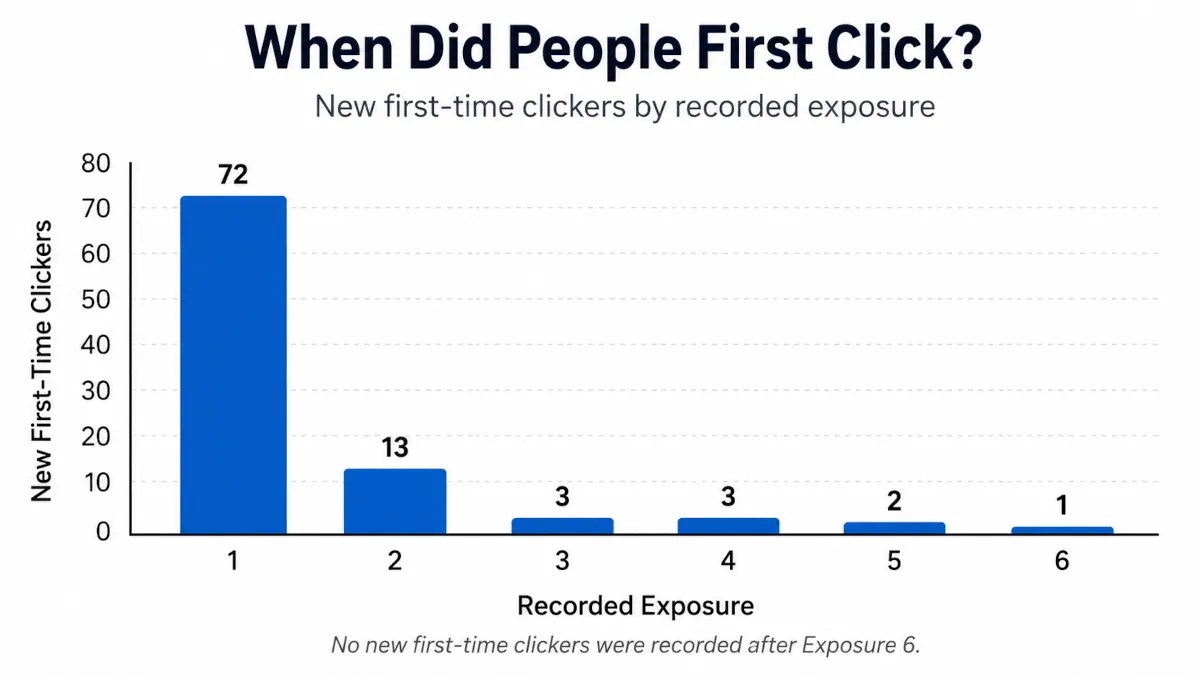
When Did People First Click?
There were 94 distinct tracked visitors who clicked the attention button at least once.
Here’s when they clicked for the first time:
The biggest takeaway is obvious.
72 of the 94 people who eventually clicked did it on their first recorded exposure.
That’s 76.6%.
So most of the attention happened right away.
But that also means 22 people — 23.4% of all eventual clickers — did not respond the first time.
Nearly one-quarter of the people who eventually clicked needed another opportunity.
That seems worth paying attention to.
The Second Exposure Was Especially Interesting
On Exposure #1, all 7,380 tracked visitors were eligible to become first-time clickers.
72 clicked.
That works out to a first-click rate of about 0.98%.
Now look at Exposure #2.
Among people who returned without having clicked the first time, 269 were still eligible to become first-time clickers.
13 of them clicked.
That works out to 4.83%.
So the first-click rate among those returners was nearly five times the rate on the first exposure.
That sounds dramatic.
But there’s an important catch.
The Second Group Was Different
I’d love to say the second exposure made people five times more likely to click.
The numbers don’t quite let me say that.
Everybody was included in Exposure #1.
Exposure #2 only included people who came back.
Those people may have been more active safelist users, more curious, more likely to revisit pages, or exposed to my campaign differently.
They were a self-selected group.
I didn’t randomly divide people into a “see it once” group and a “see it twice” group.
So this does not prove that repetition caused the higher click rate.
What it does show is that among the people who naturally returned without responding the first time, the second encounter created quite a few new responses.
That alone is useful.
A First Non-Response Wasn’t Always the End
This may be the most practical lesson for me.
It’s easy to run an ad, see that somebody didn’t respond, and assume the message failed.
Sometimes that may be true.
But in this experiment, 22 eventual clickers passed through once without clicking and responded later.
Thirteen responded on Exposure #2.
Another nine responded after that.
I can’t say exactly why.
Maybe the page looked more familiar.
Maybe they were less distracted the next time.
Maybe curiosity had another chance to work.
I don’t know.
What I do know is that one missed opportunity did not always mean the ad had lost them forever.
But More Repetition Wasn’t Automatically Better
The extra response also faded pretty quickly.
After the 13 new clickers on Exposure #2, the numbers dropped to:
- 3 on Exposure #3
- 3 on Exposure #4
- 2 on Exposure #5
- 1 on Exposure #6
- 0 after that
In this dataset, every tracked visitor who eventually clicked had done so by their sixth recorded exposure.
I would not turn that into some kind of “six exposure rule.”
The later groups were small, and this was one unusual advertising experiment.
To me, the pattern is simpler:
The first exposure did most of the work. The second created another useful opportunity. After that, new response became increasingly rare.
So How Long Should You Keep Running an Ad?
I don’t think this experiment gives us one perfect number.
What it does suggest is a reasonable middle ground.
If you have an ad that you believe is strong, don’t necessarily abandon it just because someone didn’t respond the first time.
Give it another chance.
Maybe even a few.
But don’t use repetition as an excuse to run the same ad forever either.
Eventually, you may be better off testing another headline, changing the creative, rotating the ad, or bringing it back again later.
For me, the takeaway is:
A first non-response is not always the end of the story.
Most people who noticed my experiment responded right away.
Some responded only after seeing it again.
And eventually, the supply of new attention dried up.
That feels a lot more useful than trying to force the results into some magic advertising rule.
There’s one more strange pattern hiding in the repeat-visitor data.
A small group didn’t just return and click for the first time.
They kept clicking on later visits even after they had already responded once.
That’s what I’m going to look at next.
The Safelist Attention Project
Follow the experiment from the beginning:
- I Tested 45 Safelists: Which Ones Sent Visitors Who Actually Paid Attention?
- More Traffic or More Attention? My Safelist Experiment Found They’re Not the Same
- Who Won My Safelist Experiment? I Found 4 Different Answers.
- What Made People Notice My Ad? The Eyes Barely Won.
- How Many Times Did People See My Ad Before They Clicked?
- Almost Half My Attention Clicks Came From Just 20 Visitors