Safelist marketing works—but only if you know what you’re doing. Over the years, I’ve seen the same mistakes again and again—some I’ve even made myself early on.
If you’re not getting the results you expected from safelists, chances are you’re making at least one of these. The good news? They’re all fixable.
Here are the top 5 mistakes that kill most safelist campaigns—and what to do instead.
1. Sending People Straight to a Sales Page
This is the biggest mistake people make. They grab an affiliate link or product page and blast it out through safelists… and nothing happens.
Why it fails:
You’re not building a relationship
You can’t follow up
Safelist readers are skimming—not ready to buy on the first click
What to do instead: Send people to a lead capture page first. Offer something free. Build your list. Then follow up. This one change alone can turn a dead campaign into a list-building machine.
2. Using Weak Subject Lines
Most safelist emails are deleted without ever being opened. Why? The subject lines are boring, spammy, or look like every other email in the inbox.
What to do instead: Write subject lines that make people curious. Not hype—curiosity. You’re not trying to close the deal with the subject line. You’re just trying to get the click.
3. Not Using Tracking
If you’re not tracking, you’re guessing. And if you’re guessing, you’re wasting your time.
What to do instead: Use a tracking tool (like LeadsLeap). Watch which safelists bring clicks, which ones convert, and which ones are just eating your credits. I upgrade based on my tracking. I cancel upgrades the same way. Tracking tells me what’s working and what’s not.
4. Giving Up Too Soon
Most people send a few ads, get no signups, and quit. They assume safelists don’t work. But that’s like planting a seed and walking away before it grows.
What to do instead: Consistency is key. Mail daily when you can. Rotate your ads. Test different subject lines. Safelists are about repetition and visibility over time. One ad won’t change anything—but 30 in 30 days might.
5. Promoting the Same Page Everyone Else Is Using
If you’re using the default affiliate page for a popular program, you’re probably sending traffic to a page people have seen a thousand times.
What to do instead: Create your own lead capture page—even if you’re still promoting the same offer behind the scenes. Use a fresh angle. Add a hook. Stand out. You can use tools like LeadsLeap to make your own pages or design them yourself.
Final Thoughts
Safelist marketing is a grind, but it’s not guesswork. Avoid these five mistakes, and you’ll be ahead of 90% of the people using safelists right now.
Want the full strategy I use to build my list and generate conversions? Grab a copy of Safelist Marketing Tactics and start doing it right.
One of the most common questions in safelist marketing is whether a safelist account upgrade is worth it. Should you stick with a free account—or is it time to invest?
It’s a fair question—and if you’re new to safelists, the answer can be confusing. Some people swear by paid upgrades. Others never spend a dime and still get decent results.
If you haven’t even sent your first mailing yet, I’d suggest starting with my beginner’s guide to safelist marketing. Learn how the system works with a free membership before worrying about upgrades.
Here’s the truth: Both free and paid safelist accounts can work. But knowing when—and why—to upgrade makes all the difference.
In this post, I’ll break down what I’ve learned from promoting on safelists every day, tracking results, and upgrading strategically across dozens of platforms.
What Free Safelist Accounts Offer
Free accounts are a great way to get your feet wet. You can test the platform, check response rates, and start earning credits by clicking emails.
But here’s the catch:
You’re limited in how often you can send your ads
You’ll usually be mailing every 3–7 days
Your emails compete against upgraded members for visibility
And you’re earning lower commissions if you refer anyone
If you’re consistent and tracking your results, a free account is a great starting point. But it’s not where you want to stay long-term if you’re serious about getting results.
What a Safelist Account Upgrade Unlocks
Most paid safelist upgrades unlock one key advantage: more frequent mailings.
For example: Mailing once every 3 days (10 times a month) isn’t going to perform like mailing every day (30+ times a month). More exposure means more clicks. More clicks mean more conversions—if your offer is solid.
Other perks often include:
More credits per email click
Better placement in outgoing emails
Priority support or ad approvals
Higher affiliate commissions (sometimes up to 50% recurring)
Upgrading doesn’t guarantee success—but it puts you in a much better position if you’re doing everything else right.
How I Decide When to Upgrade
I don’t upgrade blindly. I track everything.
If I see that a safelist is bringing in high activity, solid clicks, and even a few conversions—that’s when I know it’s time to level up and get more exposure.
I also look at who owns the site. If I know the admin is committed to the platform long-term, I feel much more confident investing.
Sometimes I’ll take advantage of a one-time offer when I join, especially if I trust the owner. Other times, I’ll test things as a free member and upgrade later.
Either way, it’s a strategic move—not an emotional one.
When an Upgrade Isn’t Worth It Anymore
Even a great safelist can slow down over time.
If I notice traffic is dropping, or the safelist just isn’t converting anymore, I don’t hesitate to downgrade or cancel. That’s why tracking matters. It tells you where to focus—and where to move on.
The Affiliate Commission Factor
Here’s something most people forget: upgrading often unlocks better affiliate commissions.
If you refer other members to the safelist, you can earn recurring monthly commissions—and those can easily cover your own upgrade cost (or more).
If I see that people I referred are upgrading, I’ll sometimes upgrade just to collect those higher payouts. That’s smart business.
Final Thoughts
So… free or paid?
Start with free if you’re new or just testing things out. But if you’re seeing results—or if you’re serious about list building—a paid upgrade on the right safelists can make a real difference.
Just don’t guess. Track your results. Know your numbers. Choose upgrades that support your goals.
If you’re not sure where to start, check out my latest safelist rankings to see which safelists brought in real conversions. That post is based on 30 days of tracking across dozens of sites, and it’s a great place to find your footing.
Safelist marketing gets a bad rap—mostly because people don’t know how to do it right. In fact, why most safelist marketers fail comes down to a few simple (and fixable) mistakes.
If you’ve tried safelist marketing and walked away with nothing to show for it, you’re not alone. Most marketers give up before they ever give it a real chance.
Sometimes the problem is simply not understanding how the system works. If that’s where you’re starting, my Safelist Marketing for Beginners guide walks through the basics before you get into the mistakes we’re about to discuss.
But here’s the truth: Safelists still work in 2025. You just need to understand why most people fail—so you can do the opposite. Let’s dig in.
1. They Promote the Wrong Offers
Not every offer is built for the safelist crowd. Most people are promoting high-ticket courses, weird niche products, or generic affiliate links with no hook.
What works?
Lead capture pages with a curiosity-driven hook
Simple, free offers
Anything that gets people to opt in first
Safelists are for list building, not closing big deals on first contact.
2. They Don’t Track Anything
If you’re not using tracking—like LeadsLeap—you’re flying blind. You won’t know which safelists are working, what subject lines get clicks, or how to improve.
I’ve said this over and over: Tracking is non-negotiable.
3. Their Emails Are Terrible
The average safelist inbox is a warzone of bad subject lines and spammy nonsense. If you’re writing “Get Rich Quick $$$” in the subject line, you’re getting deleted.
What works?
Curiosity-driven subject lines
Short emails with ONE goal
Making the credit link easy to find
Safelist readers are skimming. Don’t make them work.
4. They Don’t Stick With It
Most people send a few emails, get no results, and quit. That’s like going to the gym once and wondering why you don’t have abs.
You need to mail regularly, tweak as you go, and learn from your stats.
5. They Focus on the Wrong Metric
Clicks are great—but conversions are king.
You might get 1,000 clicks from a safelist that converts zero. Meanwhile, another site might bring 50 clicks and 3 sign-ups. Which one wins? The second one, every time.
That’s why my safelist rankings are based on real conversions, not just traffic.
How to Avoid Why Most Safelist Marketers Fail
If you want to actually make safelists work:
Promote a good lead capture page
Track everything
Write emails people want to click
Stay consistent
This is exactly what I teach in my book, Safelist Marketing Tactics. It’s not just theory—it’s the system I use every day to grow my business with safelists.
Final Thoughts
Safelist marketing isn’t dead. It’s just misunderstood. Most people fail because they do it wrong—but if you’re reading this, you don’t have to.
Want the full blueprint? Grab my book, Safelist Marketing Tactics, and I’ll show you exactly how to turn safelists into a powerful list-building machine.
Safelist marketing is a way to advertise your website by exchanging email advertising with other marketers. You receive promotional emails from other members, earn advertising credits by visiting their websites, and use those credits to send your own ads.
That’s the basic idea.
I’ve been using safelists for more than 20 years. I’ve also spent many of those years operating my own safelist websites, including Mister Safelist and My Daily Mailer.
I’ve seen safelists work well for some advertisers and accomplish very little for others.
And after all these years, I think the biggest difference often comes down to understanding what safelists are good at—and what they’re not.
If you’re completely new, I’ll walk you through how safelist marketing works, how to earn credits, how to send your first advertisement, and how to tell whether you’re getting worthwhile results.
Let’s start at the beginning.
What Is a Safelist?
A safelist is an advertising community where members agree to receive promotional emails from other members.
In return, they get opportunities to advertise their own websites, products, and services.
Most traditional safelists use some form of advertising credit system. Members earn credits by participating, usually by visiting websites promoted in other members’ emails.
Some safelists also offer regular mailings that don’t require credits, along with optional paid memberships and other advertising features.
One thing worth clarifying: this type of safelist isn’t the same as adding someone to your email program’s list of approved or safe senders.
We’re talking about membership-based advertising websites, sometimes called viral mailers or credit-based mailers.
And although safelists involve email, they’re different from conventional email marketing.
When you use an email marketing service, you’re generally contacting people who subscribed directly to your own mailing list.
With a safelist, you’re advertising to members of someone else’s advertising community.
You don’t own those email addresses, and joining a safelist doesn’t give you permission to export them and start mailing people yourself.
That’s an important distinction.
How Does Safelist Marketing Work?
The process is pretty simple once you’ve done it a few times.
Here’s how a typical credit-based safelist works.
1. Join a Safelist
Most safelists offer free memberships.
You create an account, verify your email address, and gain access to the member area.
Depending on the site, you might receive some starting credits or other promotional benefits.
2. Receive Advertising Emails
Other members send advertisements through the safelist.
Those messages arrive in your designated advertising inbox. Some mailers also let you browse advertisements directly from the website.
You’ll see emails promoting affiliate programs, traffic exchanges, marketing tools, websites, and all kinds of online business opportunities.
3. Visit Advertised Websites to Earn Credits
In a traditional safelist email, there’s usually a special credit link associated with the advertisement.
Clicking that link opens the advertiser’s website through the safelist’s credit system.
You may need to wait for a timer or complete a confirmation step before receiving your credits.
Simply opening the email doesn’t necessarily earn anything.
Here’s an example of what a typical safelist email looks like.
Notice the credit link near the bottom.
That’s what members click to visit the advertised website and earn advertising credits.
4. Use Your Credits to Advertise
Once you’ve earned enough credits, you can create your own promotional email.
You provide a subject line, write your message, and enter the website address you want to advertise.
The safelist sends your advertisement to eligible members according to its rules.
Some recipients will visit your website simply to earn credits.
Others might see something interesting and decide to take a closer look.
That’s the basic system: members earn advertising opportunities by participating in other members’ advertising.
Simple enough.
But there’s something beginners should understand before they start.
How Do Safelist Credits Work?
Most safelists use advertising credits, but they don’t all award or spend them in exactly the same way.
On many sites, one mailing credit lets you reach one eligible member.
For example, sending an advertisement to 1,000 members might require 1,000 credits.
Other safelists have different credit rules, mailing limits, or regular mailings that don’t require credits.
That’s why you should always check how credits are earned, how many you need to send an advertisement, and how frequently you’re allowed to mail.
There’s also an important difference between mailing credits and visitors.
Sending an email to 1,000 members doesn’t mean 1,000 people will visit your website.
Those members still need to notice your message and click through to the page you’re advertising.
A mailing creates an opportunity for exposure.
It doesn’t guarantee that everyone receiving it will be interested.
How to Get Started With Safelist Marketing
If you’re brand new, here’s exactly how I’d approach your first campaign.
Step 1: Start With One or Two Safelists
I wouldn’t join twenty safelists on your first day.
There’s no reason to make things unnecessarily complicated.
Choose one or two established mailers that clearly explain their membership levels, advertising rules, and credit systems.
Look for a website that’s reasonably easy to navigate, has an active membership, and provides a way to contact the owner or support team if you need help.
I wouldn’t make my decision based entirely on a huge advertised membership number.
What matters more is whether people are actually participating.
And don’t worry about finding the absolute best safelist right away.
For now, you just need a place to learn.
Step 2: Keep Your Safelist Email Organized
This is something I strongly recommend doing before signing up.
Don’t use your everyday personal inbox to receive safelist advertising.
Once you belong to several safelists, you can receive a substantial number of promotional emails.
Some safelists require two different email addresses.
Contact email: Used for account notifications, verification, and other important messages.
List email: Used to receive promotional emails from other members.
Other mailers have different arrangements, so follow each site’s instructions.
But whenever possible, keep your advertising emails separated from important personal messages.
Believe me, you’ll appreciate that organization later.
Step 3: Earn Enough Credits for Your First Mailing
Now it’s time to participate.
Open some safelist advertisements, visit the pages, complete the required credit steps, and build up your balance.
While you’re doing this, pay attention to the advertisements you receive.
Which subject lines make you curious?
Which messages explain their offers clearly?
Which websites make you want to look beyond the credit timer?
This is one of the easiest ways to begin learning what safelist advertising actually looks like.
And don’t feel that you need to earn thousands of credits before doing anything else.
Earn enough to try your first mailing.
You can build a bigger routine later.
Step 4: Decide What You’re Going to Advertise
I’d start with something simple and relevant to the audience.
Safelist members are generally people interested in advertising, affiliate marketing, online businesses, and related tools.
That makes them a reasonable audience for products or services that help marketers.
Traffic exchanges, advertising services, useful marketing guides, and free online tools can all make sense.
That doesn’t guarantee they’ll perform well.
It simply means the offer is relevant to the people you’re reaching.
I’d avoid trying to sell an expensive product to complete strangers with your very first email.
Instead, give people something worth looking at.
Step 5: Write a Short, Clear Advertisement
You don’t need an elaborate sales letter.
In fact, I’d keep your first advertisement pretty short.
A safelist email generally has three important parts.
The subject line: Gives someone a reason to notice your email.
The message: Explains what they’re going to find and why it might interest them.
The destination page: Delivers on the expectation created by your message.
Here’s a simple example.
Subject: Looking for another place to advertise?
Hello!
I’ve been looking at a free advertising tool that offers another way to get your website seen.
If you’re promoting an online business, it might be worth a look.
Take a minute to check it out and see whether it fits what you’re doing.
Click the credit link below to take a look.
That’s it.
There’s no giant income claim, no complicated explanation, and no attempt to convince people they’ll become wealthy overnight.
The message gives them a reason to be curious without making unrealistic promises.
Most traditional safelists automatically provide the credit link separately from your message. You enter your destination URL in the mailing form.
If you’re using a different type of mailer, follow its instructions.
Step 6: Send Your First Advertisement
Now find the mailing section in your safelist’s member area.
The layout will vary between websites, but the basic process is usually similar.
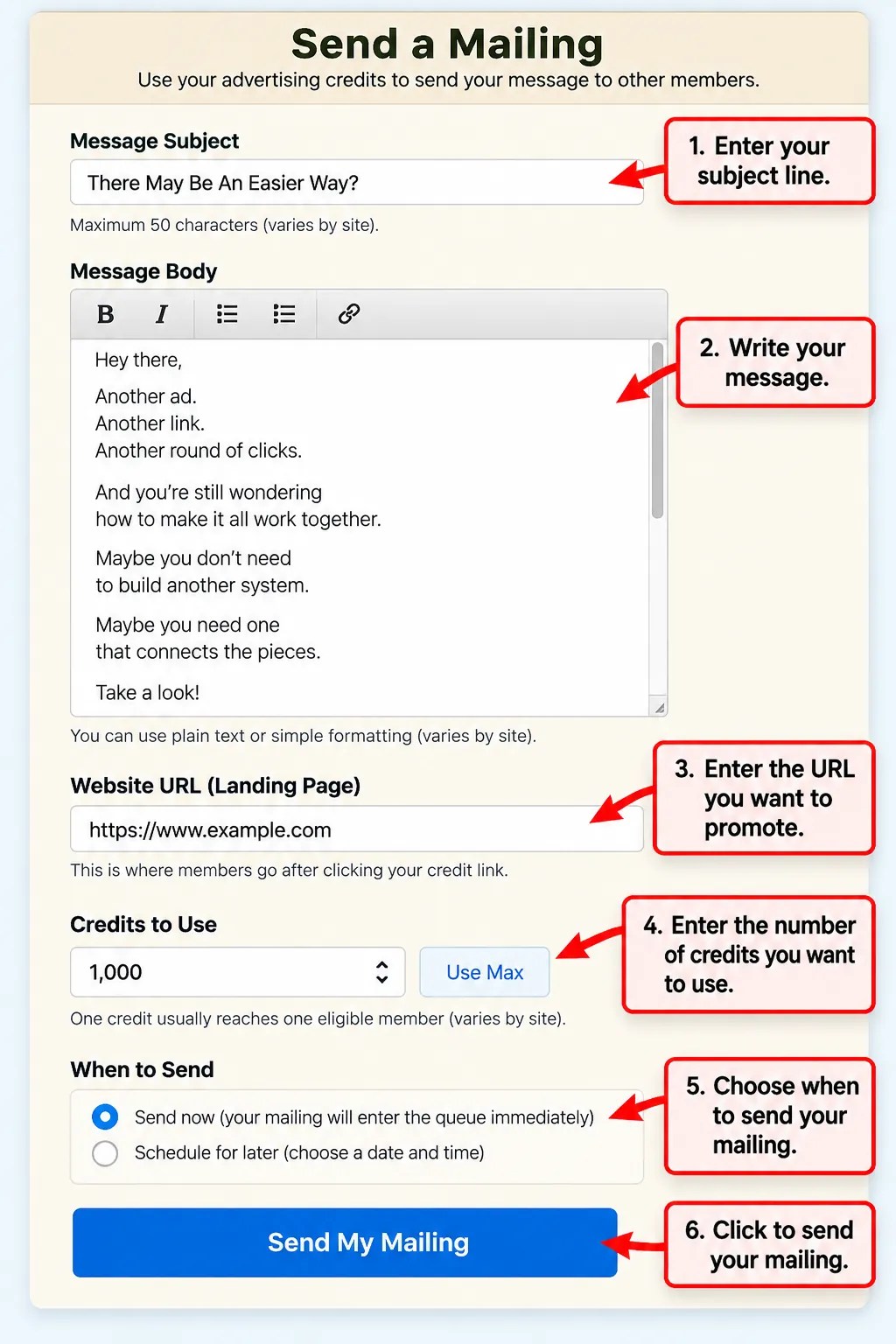
Here’s an example of a safelist mailing form.
You’ll generally need to:
Enter your email subject line.
Write your advertising message.
Enter the website URL you want visitors to reach.
Choose how many advertising credits to use.
Select when to send, if the safelist offers scheduling.
Review your settings and submit the mailing.
Before submitting, check everything carefully.
Make sure the destination page works, looks reasonable on a phone, and matches what your advertisement promised.
There’s nothing more frustrating than using your hard-earned credits to promote the wrong page.
Once your message is submitted, you’ve completed your first safelist mailing.
Congratulations!
But I wouldn’t stop there.
What Happens After You Send Your Advertisement?
This is where I think beginners can learn the most.
Your safelist might tell you how many members received or were targeted by your mailing.
A tracking service might tell you how many visitors reached your page.
And your website or signup system might tell you how many people took another action.
Those numbers measure different things.
Measurement
What It Tells You
Mailing reach
How many members your advertisement was sent to or targeted
Website visits
How many recorded visits reached your page
Engagement
Whether visitors took an additional measurable action
Conversions
Whether visitors completed your goal, such as subscribing or purchasing
The distinction matters because a large mailing can produce relatively few visits.
And even when a mailing produces lots of visits, that doesn’t mean everyone paid attention.
Which brings me to something I’ve spent quite a bit of time investigating.
Do Safelists Actually Work?
Yes, safelists can generate real visits and useful advertising exposure.
But that doesn’t mean every visitor is genuinely interested in what you’re promoting.
Remember why many members are clicking advertisements in the first place.
They’re earning credits so they can advertise their own websites.
That’s part of the arrangement.
Some members will look at your offer, become interested, and take another step.
Others will simply wait for the timer and move on.
Both can show up as visits in your statistics.
And that makes evaluating safelist traffic a little more complicated than it first appears.
What I Learned From Testing 45 Safelists
In July 2026, I ran an experiment across 45 different safelists.
Rather than promoting a product, I advertised a simple page asking visitors to click a button if they noticed what was in front of them.
There was no purchase, registration, or reward involved.
Just a voluntary action.
After reviewing the data, the experiment had:
8,392 analyzed visits
143 deliberate button clicks
94 distinct tracked clickers
1.70% overall attention rate
In other words, 1.70% of the analyzed visits produced the particular interaction I was measuring.
That’s not the same as saying only 1.70% of safelist visitors ever pay attention.
My experiment measured one specific action on one particular page. It didn’t measure sales, subscriptions, or every possible kind of engagement.
I also own two of the safelists included in the test. Some members may have recognized me or my advertising, which could have influenced their responses.
But the experiment reinforced something important.
Getting a visitor to your page and getting that visitor to pay attention are not the same thing.
Some safelists sent more traffic. Others produced a higher percentage of deliberate interactions.
But a capture page isn’t mandatory for every campaign.
You might be promoting an article, a useful tool, a membership website, or something else entirely.
The important thing is that your destination fits your goal.
What Should You Advertise on Safelists?
In my experience, offers related to internet marketing are generally a natural fit.
That might include advertising services, email marketing tools, affiliate marketing resources, online business training, or something useful for people who promote websites.
But relevance matters more than the category alone.
For example, a useful free advertising tool might get a better response than an expensive business opportunity making unrealistic income claims.
I’d also encourage you to promote things you understand.
If somebody asks you what your offer does, you should be able to explain it clearly.
And don’t promote something just because it offers a large commission.
Your reputation matters, even when you’re advertising to people you’ve never met.
Safelist Marketing vs. Traffic Exchanges
Beginners sometimes confuse safelists with traffic exchanges.
They’re related, but they aren’t quite the same.
Safelists
Traffic Exchanges
Advertising is primarily distributed through email or a mailer interface
Advertising is primarily displayed while members surf websites
Members earn advertising credits by participating in mailings
Members earn surfing credits by viewing websites
Advertisers typically write a subject line and email message
Advertisers generally submit a website URL to display
Both systems usually depend on members participating to earn advertising opportunities.
And both attract a lot of people interested in internet marketing.
For now, I’d concentrate on learning one system at a time.
Is Safelist Marketing Free?
It can be.
Most safelists offer free memberships, and many let you earn the credits you need to advertise without paying for an upgrade.
But I wouldn’t call the advertising completely free.
You’re exchanging your time for advertising opportunities.
If you spend an hour reading emails and earning credits, that’s an hour you could have spent doing something else.
As you gain experience, you’ll want to consider whether the results justify the time involved.
Paid memberships can provide more frequent mailings, additional credits, larger reach, or other advertising features.
But I wouldn’t recommend upgrading immediately.
Learn how the system works first.
Send some campaigns.
See whether your offer gets any meaningful response.
A paid upgrade can increase your advertising opportunities. It won’t automatically make your advertisement more interesting.
Five Mistakes I’d Avoid as a Beginner
1. Joining Too Many Safelists
It’s tempting to join every safelist you discover.
But then you have dozens of accounts, thousands of emails, and no real idea which sites deserve your attention.
Start small and expand when you’re ready.
2. Promoting the Wrong Offer
Safelists have a particular audience.
If your offer has nothing to do with that audience’s interests, you’re facing an uphill battle.
I’d rather promote something relevant than force an unrelated product in front of as many people as possible.
3. Expecting Every Visit to Become a Lead or Sale
Safelist traffic is often motivated by credits.
Some visitors will be interested. Many won’t.
That’s why your message, offer, and destination page matter so much.
4. Sending the Same Advertisement Without Learning Anything
Repetition isn’t automatically bad.
Sometimes people need to see something more than once before they notice it.
But if you’re getting visits and no meaningful response, try improving something.
Maybe the subject line needs work.
Maybe the landing page is confusing.
Maybe you’re advertising the wrong thing.
Make one change at a time so you have a better chance of understanding what helped.
5. Spending Money Before You Understand the Results
An upgrade can be useful when you know what you’re doing.
But paying for more advertising doesn’t guarantee more leads or sales.
I’d start with free memberships, learn the process, and make decisions based on what happens.
Frequently Asked Questions About Safelist Marketing
Can You Make Money With Safelist Marketing?
Possibly, but safelists don’t pay you simply for sending advertisements.
They provide advertising opportunities.
You might use those opportunities to promote an affiliate program, build a mailing list, or bring visitors to a product or service.
Whether you make money depends on what you’re advertising and whether visitors take the action you’re hoping for.
There are no guaranteed sales.
Is Safelist Marketing Spam?
Safelist members agree to receive promotional messages as part of their membership.
That makes the arrangement different from collecting random email addresses and sending unsolicited advertisements.
But member consent doesn’t automatically guarantee inbox delivery or compliance with every applicable email-marketing law.
You should use the safelist’s own mailing system, follow its policies, and never assume you can take its member addresses and use them independently.
How Many Safelists Should a Beginner Join?
I’d start with one or two.
Learn how to earn credits, send advertisements, and track your results.
Then add others if you find the process useful.
There’s no prize for collecting the most safelist memberships.
Do I Need My Own Website?
You need a destination for your advertisement, but it doesn’t necessarily have to be a website you built yourself.
Some advertisers promote affiliate pages, landing pages, blogs, or membership programs.
The important thing is that the page follows the safelist’s rules, works properly, and gives visitors a clear reason to continue.
Do I Need a Lead Capture Page?
Not necessarily.
A capture page can make sense if your goal is to build an email list.
But you can also promote articles, useful resources, membership websites, and other offers.
What matters is having a clear purpose for the visit.
My Advice for Your First Safelist Campaign
If I were just getting started today, I wouldn’t worry about advanced strategies.
I’d keep my first campaign simple.
Join one or two safelists.
Earn enough credits to send an advertisement.
Write a short email promoting something relevant to the audience.
Send it to a page with one clear purpose.
Then see what happens.
Once you understand that process, you can experiment with better subject lines, different offers, more safelists, and paid memberships if they make sense.
There’s plenty of time for all that.
You don’t need to master everything on your first day.
Final Thoughts
Safelist marketing has been part of my online advertising routine for more than 20 years.
I still use it because it gives me a straightforward way to get my advertising in front of other marketers.
But I also understand its limitations.
Not every message gets noticed.
Not every visit represents genuine interest.
And not every campaign produces the results you’re hoping for.
That’s why I think the best way to approach safelists is as an advertising tool you can learn, test, and improve—not a shortcut to instant sales.
Start with one mailing. Learn from the results. Then make your next one a little better.
That’s a much better foundation than joining dozens of safelists and sending advertisements without knowing what’s actually working.
Have you used safelists before, or are you just getting started?
I’d be interested to hear about your experience in the comments.
Most marketers treat safelist marketing as a numbers game—send as many emails as possible and hope for the best. But without proper tracking, you’re flying blind. How do you know which safelists are actually working for you? How can you tell if your emails are effective? Tracking your safelist campaign performance is the key to maximizing results and making data-driven decisions. In this post, we’ll break down exactly how to track and optimize your safelist marketing efforts for better conversions.
Why Tracking Your Safelist Campaigns Matters
Safelist marketing requires time and effort, so it’s essential to know if your strategy is working. Tracking allows you to:
Measure effectiveness – See which safelists are bringing in the best results.
Optimize campaigns – Identify what works and what doesn’t, then adjust accordingly.
Save time and resources – Focus on high-performing safelists instead of wasting time on poor performers.
Key Metrics to Monitor
Not all clicks are created equal.
I got a particularly interesting look at this when I tested 45 safelists to see which ones sent visitors who actually paid attention. Instead of simply counting page visits, I asked visitors to take one deliberate action to show they had noticed the page. The results reinforced something I’ve believed for years: traffic numbers alone don’t tell you nearly enough.
The following metrics will help you determine the success of your safelist campaigns:
1. Conversions (Most Important!)
The ultimate goal of safelist marketing is conversions—sign-ups or sales.
If a safelist isn’t bringing in conversions, it may not be worth your time.
2. Traffic Volume
High traffic is good, but quality traffic is better.
If you’re getting tons of clicks but no sign-ups, it could mean your landing page isn’t compelling or the audience isn’t a good fit.
3. Response Rate
Response refers to the number of people who clicked but did not sign up.
A high response rate means the safelist is active, but your offer may need tweaking.
This metric helps you see if you’re attracting real engagement or just empty clicks.
Effective Tracking Tools
You need the right tools to track safelist performance accurately. Here are the best options:
Tracks clicks, conversions, and engagement in real time.
Provides in-depth analytics so you can fine-tune your safelist strategy.
2. Other Tracking Tools
If you use multiple tracking solutions, compare data for consistency.
Always focus on tools that provide insights on both clicks and conversions.
Best Practices for Improving Campaign Performance
Tracking alone won’t improve your results—you also need to act on the data. Here’s how:
1. Use Curiosity-Driven Subject Lines
The best-performing emails spark curiosity and encourage opens.
Avoid generic, overused subject lines that get ignored.
2. Keep Emails Short and Focused
Readers shouldn’t have to scroll through paragraphs of text to find the credit link.
Get them to your page quickly and let your landing page do the talking.
3. Rotate and Refresh Your Landing Pages
Using the same pages repeatedly can lead to lower engagement over time.
Try fresh pages, test new offers, and keep things visually appealing.
4. Monitor and Adjust Based on Data
Regularly check your tracking stats to identify top-performing safelists.
Stop using safelists that don’t produce results.
Common Mistakes to Avoid
Even experienced marketers make tracking mistakes. Here’s what not to do:
1. Not Tracking at All
The biggest mistake is guessing instead of using real data.
Without tracking, you have no way of knowing what’s working.
2. Ignoring Data Trends
If a safelist suddenly drops in performance, investigate why.
Watch for trends that indicate a shift in effectiveness.
3. Sticking with Underperforming Safelists
If a safelist isn’t delivering traffic or conversions, cut it loose.
Focus your efforts on safelists that consistently perform.
Conclusion
Tracking your safelist marketing campaigns is not optional if you want to maximize your results. By monitoring key metrics, using the right tracking tools, and making data-driven adjustments, you can dramatically improve your conversion rates and overall efficiency.
Want to take your safelist marketing to the next level? Grab a copy of my Safelist Marketing Tactics book to discover advanced strategies for getting the best results!