My Daily Mailer: Year 1

My Daily Mailer Year 1 featured image with a morning workspace, coffee, laptop, and sunrise view

My Daily Mailer is officially one year old.

That feels a little strange to write.

A year ago, I had an idea I thought was pretty cool. I knew how I wanted it to work. I had spent a lot of time thinking through the logic behind it.

But there is always one question you can’t answer until you put something in front of real people:

Will it actually work?

After one full year of My Daily Mailer, I finally have an answer.

I think it did.

And looking back through the numbers, I may actually like the idea behind it more now than I did when I launched it.

The Idea I Really Wanted to Test

I’ve been using safelists since 2003.

I’ve promoted on them, tracked them, written about them and operated them. I’ve watched the industry change quite a bit while the basic mechanics of a safelist stayed surprisingly similar.

One thing kept bothering me.

The economics of a traditional mailer don’t naturally balance themselves.

Members earn credits. Sites give away credits. Upgrades create credits. Promotions create credits. Balances accumulate.

Eventually, those credits turn into mail.

But there isn’t necessarily any connection between the amount of mailing power being created and the amount of activity available to support all that mail.

That was the problem I wanted to play with.

With My Daily Mailer, one Mail Token has a very specific value: one mailing.

But that’s not the clever part.

The part I still think is coolest is this:

The amount of MT members earn for reading changes based on how active the mailer is.

The economy responds to the mailer itself.

Member activity helps determine how much future mailing power gets created.

As conditions inside the site change, the earning rate can change with them.

Instead of constantly trying to force balance from the outside, the system is designed to move toward balance on its own.

It’s a little nerdy.

I know.

But I still love it.

The Members ARE the Economy

That’s also why My Daily Mailer depends so much on participation.

When somebody reads an email, they’re not simply clicking to collect an arbitrary pile of credits.

Their activity is part of the system.

Reading creates the conditions that allow mailing.

Mailing creates new messages to read.

Those reads create more mailing power.

And around it goes.

That’s the experiment I wanted to run.

Could a safelist economy regulate itself based on what the members were actually doing?

A year later, we’ve had enough real activity to give that idea a pretty serious test.

Year 1 By the Numbers

I pulled a full 365-day report directly from the My Daily Mailer database for this anniversary.

During Year 1:

  • More than 2,700 members joined My Daily Mailer
  • Members sent 28,305 mailings
  • Those mailings produced almost 15 million emails
  • Members earned 32,531 MTs
  • The mailer delivered more than 1.76 million reading hits
  • More than 100 members made upgrade payments

Those are real numbers from a real year of people actually using the site.

And I’m proud of them.

But there is another part of the report I like even more.

Month 12 Tells Me More Than Month 1

Launch numbers are fun.

They’re also dangerous.

You can launch something new and get a flood of curiosity.

People join because their friends are talking about it.

Affiliates promote it.

Everybody clicks around to see what’s new.

Then six months later…

Crickets.

So when I went through the Year 1 report, I wasn’t especially interested in proving that My Daily Mailer had a good launch.

I wanted to know what happened after everybody stopped caring that it was new.

September 2026 was month twelve.

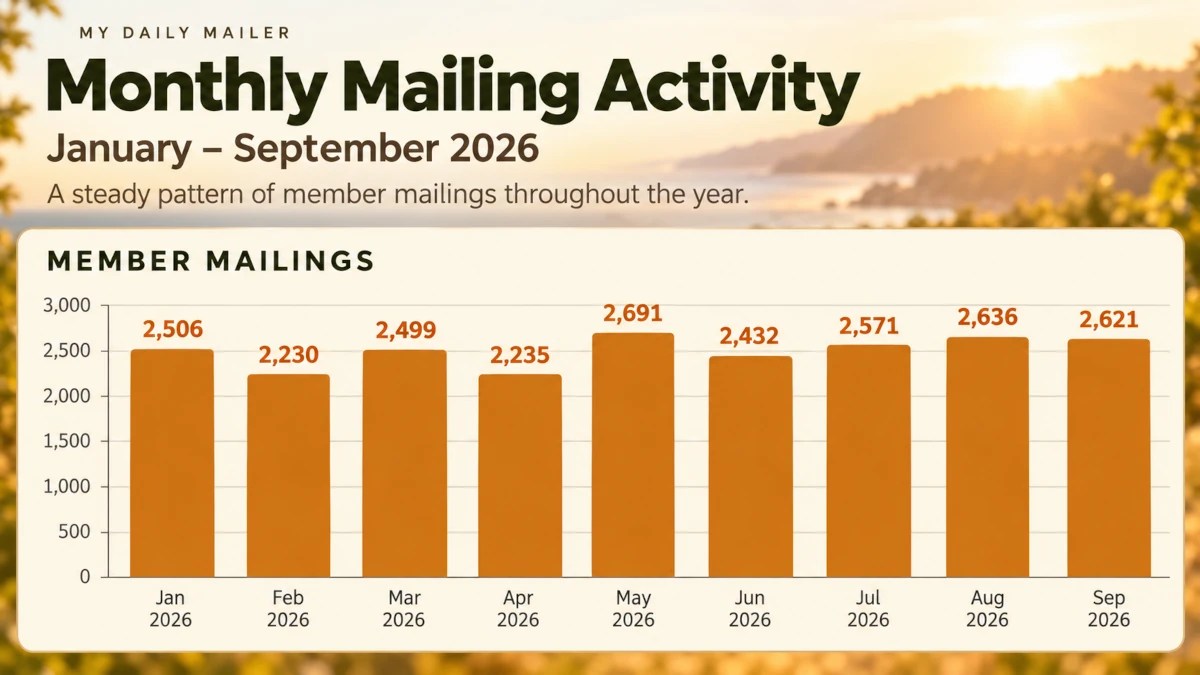
During that month, members sent 2,621 mailings.

Those mailings generated more than 1.35 million emails.

The system delivered 174,812 reading hits.

And on an average day, about 144 members were actively reading mail.

That’s month twelve.

Even more interesting, the mailing volume throughout 2026 was remarkably consistent.

Not one giant launch spike followed by a slow fade.

People found a rhythm.

They read.

They earned MTs.

They mailed.

Then they came back and did it again.
Some Members REALLY Use My Daily Mailer

The Year 1 report also reminded me how much of the site is driven by a relatively small group of extremely active members.

There were 270 members who completed at least 500 reads during the first year.

Together, those members accounted for more than 1.13 million completed reads.

And 243 of those heavy readers also sent mailings.

I love that.

Because that’s the system doing exactly what it was designed to do.

The people doing the reading aren’t trapped on one side of the equation.

They’re earning the ability to become senders themselves.

Read.

Earn.

Mail.

Repeat.

The economy keeps circulating.

And to those members who have spent hundreds—or thousands—of reads helping keep that cycle moving:

Thank you.

My Daily Mailer would just be software without you.

Then I Accidentally Tested It Against Everybody Else

One of my favorite moments of My Daily Mailer’s first year didn’t actually happen inside My Daily Mailer.

Earlier this year, I ran a safelist experiment for this blog.

I sent the same simple page through 40 different safelists.

There was no sale.

No opt-in.

No prize for clicking.

Visitors were simply asked to look at the page and choose whether they wanted to interact with it.

I wasn’t testing My Daily Mailer.

I wasn’t trying to prove anything about my own site.

I was testing attention.

And when I looked at the results, My Daily Mailer stood out.

By a lot.

Its visitors interacted with the page at a dramatically higher rate than the other safelists in the test.

Now, there are several possible reasons for that.

Members know me.

Lucky Letters give people a reason to pay attention.

The member base is active.

And the structure of the mailer may encourage a different kind of reading behavior.

I can’t separate all of those things perfectly.

But seeing My Daily Mailer stand out in an experiment I hadn’t designed to make it look good was pretty satisfying.

Especially because one of the things I wanted from the beginning was a mailer where activity actually meant something.

Year 1 Wasn’t Just Running the Site

Of course, I didn’t launch My Daily Mailer and then spend twelve months admiring it.

I tinkered with it.

A lot.

Lucky Letters became part of the experience.

I built a better contest system.

We now have reader contests and weekly reader sprints.

I added clearer guidance for new members who hadn’t yet figured out how to earn their first MT.

I watched the activation reports.

I changed things.

Then I watched again.

Some ideas worked.

Some didn’t.

Some things that seemed obvious to me were apparently not obvious at all once a new member landed on the site.

That’s one of the biggest differences between designing something and operating it.

Real members find every assumption you made.

That’s a good thing.

They make the product better.

The Site Is Still Evolving

My Daily Mailer is not finished.

I don’t really expect it ever to be.

That doesn’t mean I’m constantly trying to reinvent it.

The basic idea has held up remarkably well.

The self-balancing economy is still the part I believe in most.

But there are always ways to make the experience clearer, smoother, more useful or more fun.

Sometimes that means a new feature.

Sometimes it means changing a paragraph.

Sometimes it means staring at a report and realizing new members aren’t doing what I thought they were doing.

And sometimes it means spending far too long adjusting something that nobody except me will ever notice.

That’s part of running a site.

If You’ve Never Tried My Daily Mailer

If you’ve never joined, Year 2 seems like a pretty good time.

You can join for free.

You don’t need to understand the economics before you start using it.

Just read some member emails.

Watch your MT balance.

Earn a mailing.

Then use it.

You’ll figure out the rhythm pretty quickly.

And underneath that simple process is a system that’s constantly responding to the activity of the people using it.

That’s the part I’m proudest of.

Join My Daily Mailer

To Everyone Who Made Year 1 Possible

I built My Daily Mailer.

But I didn’t create what it became during Year 1.

The members did that.

Every person who opened an email helped create the economy.

Every person who sent a mailing gave somebody else something to discover.

Every affiliate who referred a member helped it grow.

Every Prime member who decided the site was worth paying for gave me another vote of confidence.

Every contest participant, Lucky Letter hunter and regular reader added a little more life to the place.

That’s what I see when I look at the Year 1 report.

Not 15 million emails.

People.

People using something I built.

People coming back.

People making the system work.

A year ago, My Daily Mailer was an idea I wanted to test.

Today, it’s a working mailer with thousands of members and a full year of real activity behind it.

That’s pretty awesome.

Thank you for Year 1.

Now let’s see what happens in Year 2.

— Jerry

My Daily Mailer

Safelist Marketing Trends: What to Expect in 2026

Illustration of a person working at a desk in a warm home office, looking out a window at a sunrise over rolling hills while thinking about the future of safelist marketing in 2026.

As 2025 wraps up, I’ve been thinking a lot about the conversations we’ve had this year — the frustrations, the breakthroughs, the wins, the losses, and everything in between. It’s been a year of change not just for me, but for safelist marketers everywhere.

If you’ve been following along, you’ve probably noticed a pattern in the topics we’ve covered. One post after another kept circling back to the same truth:

Safelist marketing isn’t the problem.

What trips most people up is how they approach it – their expectations, their ads, and their consistency over time.

After watching this play out for years, I started wondering whether a different structure could make it easier for more people to stay consistent and get better results, without changing what makes safelists effective in the first place.

And as we look ahead to 2026, it feels like the right time to bring all of this together and talk openly about where safelist marketing is headed — and why I think the best days are still ahead of us.


What We’ve Learned Over the Past Year

This year covered a lot of ground. We dug into the traditional credit system and the limitations that emerged over time. We talked about the changing landscape of safelists. We looked at what makes ads work (and why so many don’t). We talked about productivity, personal branding, splash-page design — and how every piece affects your results.

Here are the big lessons that kept surfacing:

– Most people don’t struggle because safelists “don’t work.” They struggle because they’ve never been shown how to build ads people want to click.
– Safelists have evolved dramatically since the early 2000s, and not always for the better. But every change showed us what works and what doesn’t.
– Branding matters. Your face, your story, your tone — all of it makes a difference.
– Productivity matters. Working from home is great, but it only works if you stay focused and consistent.
– Creativity matters. Good splash pages, good copy, and good tracking tools can completely change your results.

And maybe the biggest lesson of all:

If this industry is going to grow again, we need to start thinking about new ideas and not just refining the same approaches we’ve relied on for years.


Where Safelist Marketing Is Going Next

Safelists aren’t disappearing. They’re too useful, too flexible, and too reliable when they’re done right. But we are entering a new phase — one that demands more from all of us.

The future looks like this:

– more fairness
– more balance
– more predictable results
– fewer wasted emails
– better user experiences
– real engagement instead of noise

Safelists should feel productive.
They should feel rewarding.
They should feel worth the time you invest in them.

And honestly, they should be enjoyable again.

That’s the direction I believe this industry is moving toward — and it’s something I’ve been working on behind the scenes for a long time.


Why Mail Tokens Are the Turning Point

The Mail Token (MT) system at My Daily Mailer wasn’t created as a “cool idea” or a way to stand out.

It started as an experiment – a way to rethink how mailers are structured while keeping the core idea intact.

So far, it’s shown promise as a more balanced way to manage activity and volume:

– One MT equals one mailing.
– You earn MTs through real activity.
– Supply stays predictable.
– Mail volume remains manageable.

Just a clean, steady, fair system that works for beginners and experienced marketers alike.

My goal with My Daily Mailer was never to replace safelists.
It was to explore a different structure that might help them thrive in a new way.

And I’m proud of how far it’s come in such a short amount of time.


What You Should Start Doing Going Into 2026

If you’re ready to make real progress in the coming year, here’s what I’d focus on:

– Build your personal brand. People click what feels real — especially now.
– Rotate your ads. Even the best ad stops working if it never changes.
– Track your results. Don’t guess. Know.
– Start building a list if you haven’t already. This is how you turn traffic into long-term income.
– Be consistent. Even small daily actions compound over time.

None of this is complicated.
None of it requires magic formulas.
But it works — and it works year after year.


A Personal Note as We Close Out the Year

I’ve been doing this since 2003, and I can honestly say this has been one of the most transformative years of my entire journey. Watching safelists evolve, building My Daily Mailer, reconnecting with old ideas, and pushing the boundaries of what a safelist can be — it’s been exhausting at times, but incredibly rewarding.

And I’m more excited about this industry today than I’ve been in a decade.

I believe safelist marketing still has a bright future.
I believe beginners can still get meaningful results.
I believe experienced marketers can still scale.
And I believe we can create an environment where everyone wins — not just the people sending the most mail.

Thank you for reading my posts this year.
Thank you for being part of this corner of the internet.
And thank you for believing in the idea that we can make this industry better.

Because we can.
And we will.


If You Want to Be Part of What’s Coming Next

If you want a safelist that finally feels balanced, predictable, and genuinely productive again, you’re invited to take a look at My Daily Mailer.

It’s live.
It’s working.
And it’s only getting better from here.

Here’s to the next chapter.
Here’s to a stronger, smarter safelist industry.
And here’s to a great year ahead.

— Jerry

Why the Traditional Safelist Credit System Is Broken — and How Mail Tokens Fix Everything

A cleaner, fairer way to get real safelist results

Safelist marketing has been running on the same credit-based system for more than two decades. And if you’ve been around long enough, you already know the truth:

Credits don’t work like they used to.

Results have dropped.
Inboxes have exploded.
And more marketers than ever are wondering whether safelists are even worth the effort anymore.

I’ve been using safelists since 2003, and over the years I’ve watched the entire model slowly grind itself into the ground. Not because people stopped trying — but because the system itself stopped supporting good results.

It’s time we talk about why.


The Credit System Was Doomed From the Start

Traditional safelists run on a simple idea:

Click emails → earn credits → send your own emails.

In the early days, it was revolutionary. But as the industry grew, something predictable (and unavoidable) happened.

1. Credit Inflation Killed the Value

The more credits members earn,
the more emails they send.
The more emails they send,
the less attention each email gets.

It’s a loop that feeds on itself.

And every year, the gap widens:

  • More emails go out
  • Fewer people actually read them
  • Everyone needs more credits just to keep up
  • The value of each credit keeps sinking

It’s inflation — just a digital version of it.

2. Too Many Emails, Not Enough Attention

When credits inflate, emailing becomes a volume war.

You don’t send ads because they’re good.
You send ads because you feel like you’ll fall behind if you don’t.

But the inbox side of the equation never improves. Members open fewer messages. They skim. They miss things. Or they just click the first open credit link and move on.

3. Clicking Becomes a Chore

This is the part that frustrated me the most.

You’d spend 30 minutes clicking your way to enough credits for a mailing — and then maybe get a handful of clicks back.

You never felt caught up.
You never felt productive.
You always felt a step behind the flood of incoming mail.

And honestly?
That alone has driven more people away from safelists than anything else.


What Safelist Marketers Actually Want

After 20+ years of running and promoting safelists, I can tell you exactly what most people want:

  • Predictable results
  • Fairness
  • Steady engagement
  • A sense of control
  • A reason for clicking besides obligation

Most importantly, they want to feel like their time matters again.

That feeling has been missing for a long time.


The Moment I Knew Something Had to Change

There wasn’t one big dramatic moment — it was a buildup over years.

But the moment that finally got to me was when I found myself telling a new marketer:

“Just keep clicking and hope for the best.”

And as soon as I said it, I realized how ridiculous that advice was.

This industry wasn’t broken because people stopped trying.
It was broken because the currency powering it — credits — had collapsed.

That’s when I knew something new needed to be built from the ground up.


Introducing the Mail Token System (MTs)

Mail Tokens (MTs) flip the entire safelist model on its head.

Here’s the core idea:

Earn MTs by reading emails.
Spend exactly 1 MT to send to the entire list.
The system adapts automatically so nothing gets overloaded.

That’s it.
Simple.
Balanced.
Predictable.

Why MTs Work (When Credits Don’t)

When we started testing MTs, something amazing happened:

  • Members earned MTs at a steady, predictable pace
  • The inbox stayed healthy
  • Mail volume didn’t spiral out of control
  • The sending cost never inflated
  • People understood the value of what they were earning

The moment the MT rate dipped below 0.01 for members — and they liked it — I knew it was working.

Instead of crashing the system, it adapted instantly.

No inflation.
No abuse.
No chaos.

Just balance.


Why the Mail Token System Is Fairer for Everyone

Credits reward the biggest clickers.
MTs reward consistent, engaged users.

That’s the difference.

  • Everyone earns MTs at the same daily rate for their group
  • Everyone spends exactly 1 MT to send
  • You can’t game the system
  • You can’t inflate it
  • You can’t overload the inbox

It’s truly the first system I’ve seen that benefits the individual and the community at the same time.


Where Safelist Marketing Needs to Go Next

My vision is simple:

A clean, balanced, results-driven ecosystem where every email gets seen, every click matters, and members finally feel like their effort is paying off.

We’re not there yet — but we’re closer than ever.


Final Thoughts

If you’re tired of wasting time on safelists that don’t deliver, it’s time to try something built for today — not twenty years ago.

The Mail Token System is live inside My Daily Mailer, and thousands of emails have already been sent through it with real, consistent engagement.

No inflation.
No chaos.
No guessing.
Just a system that finally works the way safelist marketing should.

My Daily Mailer is open right now.
Join us and see the difference for yourself.

My Daily Mailer