
Updated October 27, 2026
Hello!
Safelist marketing is a way to advertise your website by exchanging email advertising with other marketers. You receive promotional emails from other members, earn advertising credits by visiting their websites, and use those credits to send your own ads.
That’s the basic idea.
I’ve been using safelists for more than 20 years. I’ve also spent many of those years operating my own safelist websites, including Mister Safelist and My Daily Mailer.
I’ve seen safelists work well for some advertisers and accomplish very little for others.
And after all these years, I think the biggest difference often comes down to understanding what safelists are good at—and what they’re not.
If you’re completely new, I’ll walk you through how safelist marketing works, how to earn credits, how to send your first advertisement, and how to tell whether you’re getting worthwhile results.
Let’s start at the beginning.
What Is a Safelist?
A safelist is an advertising community where members agree to receive promotional emails from other members.
In return, they get opportunities to advertise their own websites, products, and services.
Most traditional safelists use some form of advertising credit system. Members earn credits by participating, usually by visiting websites promoted in other members’ emails.
Some safelists also offer regular mailings that don’t require credits, along with optional paid memberships and other advertising features.
One thing worth clarifying: this type of safelist isn’t the same as adding someone to your email program’s list of approved or safe senders.
We’re talking about membership-based advertising websites, sometimes called viral mailers or credit-based mailers.
And although safelists involve email, they’re different from conventional email marketing.
When you use an email marketing service, you’re generally contacting people who subscribed directly to your own mailing list.
With a safelist, you’re advertising to members of someone else’s advertising community.
You don’t own those email addresses, and joining a safelist doesn’t give you permission to export them and start mailing people yourself.
That’s an important distinction.
How Does Safelist Marketing Work?
The process is pretty simple once you’ve done it a few times.
Here’s how a typical credit-based safelist works.
1. Join a Safelist
Most safelists offer free memberships.
You create an account, verify your email address, and gain access to the member area.
Depending on the site, you might receive some starting credits or other promotional benefits.
2. Receive Advertising Emails
Other members send advertisements through the safelist.
Those messages arrive in your designated advertising inbox. Some mailers also let you browse advertisements directly from the website.
You’ll see emails promoting affiliate programs, traffic exchanges, marketing tools, websites, and all kinds of online business opportunities.
3. Visit Advertised Websites to Earn Credits
In a traditional safelist email, there’s usually a special credit link associated with the advertisement.
Clicking that link opens the advertiser’s website through the safelist’s credit system.
You may need to wait for a timer or complete a confirmation step before receiving your credits.
Simply opening the email doesn’t necessarily earn anything.
Here’s an example of what a typical safelist email looks like.

Notice the credit link near the bottom.
That’s what members click to visit the advertised website and earn advertising credits.
4. Use Your Credits to Advertise
Once you’ve earned enough credits, you can create your own promotional email.
You provide a subject line, write your message, and enter the website address you want to advertise.
The safelist sends your advertisement to eligible members according to its rules.
Some recipients will visit your website simply to earn credits.
Others might see something interesting and decide to take a closer look.
That’s the basic system: members earn advertising opportunities by participating in other members’ advertising.
Simple enough.
But there’s something beginners should understand before they start.
How Do Safelist Credits Work?
Most safelists use advertising credits, but they don’t all award or spend them in exactly the same way.
On many sites, one mailing credit lets you reach one eligible member.
For example, sending an advertisement to 1,000 members might require 1,000 credits.
Other safelists have different credit rules, mailing limits, or regular mailings that don’t require credits.
That’s why you should always check how credits are earned, how many you need to send an advertisement, and how frequently you’re allowed to mail.
There’s also an important difference between mailing credits and visitors.
Sending an email to 1,000 members doesn’t mean 1,000 people will visit your website.
Those members still need to notice your message and click through to the page you’re advertising.
A mailing creates an opportunity for exposure.
It doesn’t guarantee that everyone receiving it will be interested.
How to Get Started With Safelist Marketing
If you’re brand new, here’s exactly how I’d approach your first campaign.
Step 1: Start With One or Two Safelists
I wouldn’t join twenty safelists on your first day.
There’s no reason to make things unnecessarily complicated.
Choose one or two established mailers that clearly explain their membership levels, advertising rules, and credit systems.
Look for a website that’s reasonably easy to navigate, has an active membership, and provides a way to contact the owner or support team if you need help.
I wouldn’t make my decision based entirely on a huge advertised membership number.
What matters more is whether people are actually participating.
And don’t worry about finding the absolute best safelist right away.
For now, you just need a place to learn.
Step 2: Keep Your Safelist Email Organized
This is something I strongly recommend doing before signing up.
Don’t use your everyday personal inbox to receive safelist advertising.
Once you belong to several safelists, you can receive a substantial number of promotional emails.
Some safelists require two different email addresses.
Contact email: Used for account notifications, verification, and other important messages.
List email: Used to receive promotional emails from other members.
Other mailers have different arrangements, so follow each site’s instructions.
But whenever possible, keep your advertising emails separated from important personal messages.
Believe me, you’ll appreciate that organization later.
Step 3: Earn Enough Credits for Your First Mailing
Now it’s time to participate.
Open some safelist advertisements, visit the pages, complete the required credit steps, and build up your balance.
While you’re doing this, pay attention to the advertisements you receive.
Which subject lines make you curious?
Which messages explain their offers clearly?
Which websites make you want to look beyond the credit timer?
This is one of the easiest ways to begin learning what safelist advertising actually looks like.
And don’t feel that you need to earn thousands of credits before doing anything else.
Earn enough to try your first mailing.
You can build a bigger routine later.
Step 4: Decide What You’re Going to Advertise
I’d start with something simple and relevant to the audience.
Safelist members are generally people interested in advertising, affiliate marketing, online businesses, and related tools.
That makes them a reasonable audience for products or services that help marketers.
Traffic exchanges, advertising services, useful marketing guides, and free online tools can all make sense.
That doesn’t guarantee they’ll perform well.
It simply means the offer is relevant to the people you’re reaching.
I’d avoid trying to sell an expensive product to complete strangers with your very first email.
Instead, give people something worth looking at.
Step 5: Write a Short, Clear Advertisement
You don’t need an elaborate sales letter.
In fact, I’d keep your first advertisement pretty short.
A safelist email generally has three important parts.
The subject line: Gives someone a reason to notice your email.
The message: Explains what they’re going to find and why it might interest them.
The destination page: Delivers on the expectation created by your message.
Here’s a simple example.
Subject: Looking for another place to advertise?
Hello!
I’ve been looking at a free advertising tool that offers another way to get your website seen.
If you’re promoting an online business, it might be worth a look.
Take a minute to check it out and see whether it fits what you’re doing.
Click the credit link below to take a look.
That’s it.
There’s no giant income claim, no complicated explanation, and no attempt to convince people they’ll become wealthy overnight.
The message gives them a reason to be curious without making unrealistic promises.
Most traditional safelists automatically provide the credit link separately from your message. You enter your destination URL in the mailing form.
If you’re using a different type of mailer, follow its instructions.
Step 6: Send Your First Advertisement
Now find the mailing section in your safelist’s member area.
The layout will vary between websites, but the basic process is usually similar.
Here’s an example of a safelist mailing form.
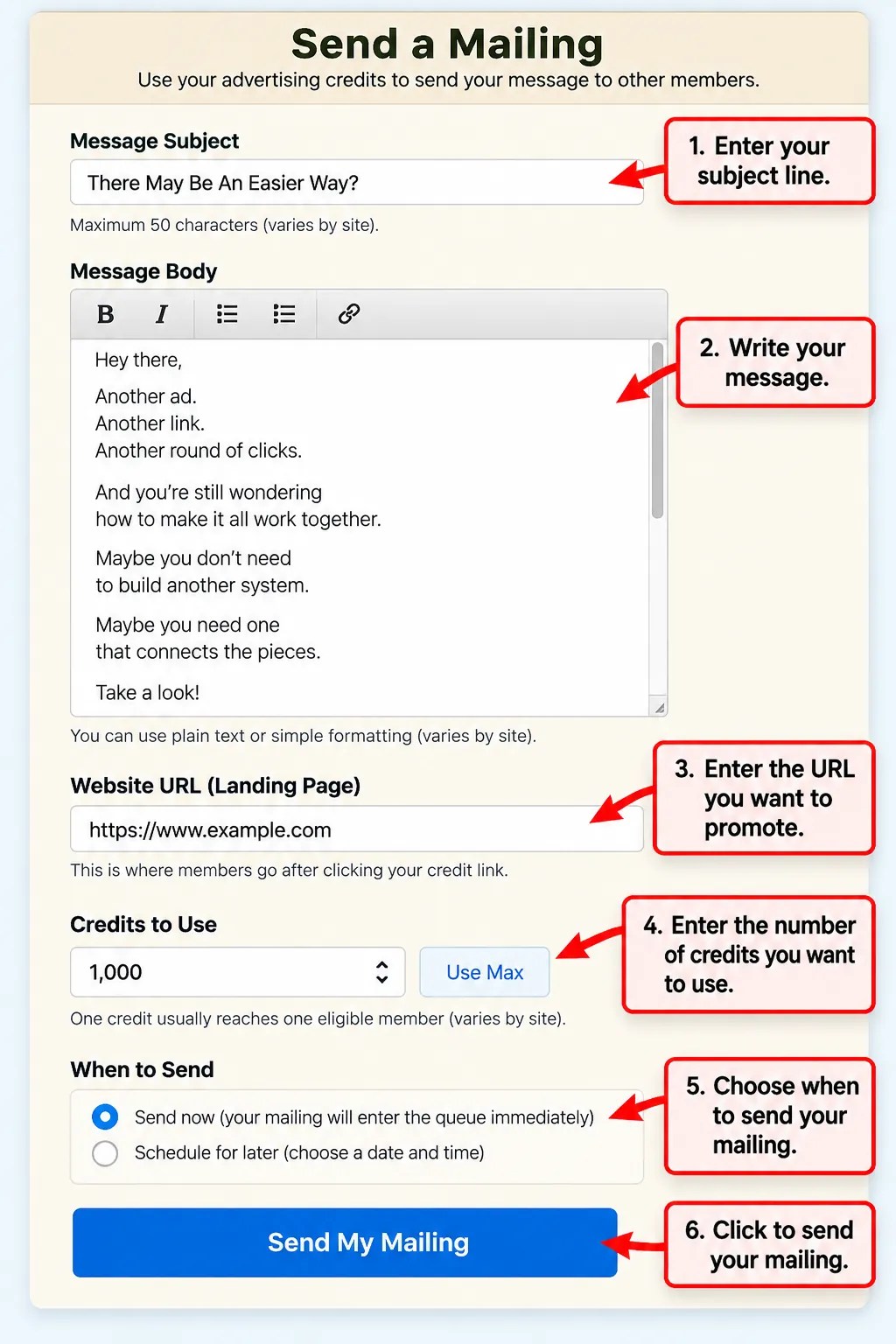
You’ll generally need to:
- Enter your email subject line.
- Write your advertising message.
- Enter the website URL you want visitors to reach.
- Choose how many advertising credits to use.
- Select when to send, if the safelist offers scheduling.
- Review your settings and submit the mailing.
Before submitting, check everything carefully.
Make sure the destination page works, looks reasonable on a phone, and matches what your advertisement promised.
There’s nothing more frustrating than using your hard-earned credits to promote the wrong page.
Once your message is submitted, you’ve completed your first safelist mailing.
Congratulations!
But I wouldn’t stop there.
What Happens After You Send Your Advertisement?
This is where I think beginners can learn the most.
Your safelist might tell you how many members received or were targeted by your mailing.
A tracking service might tell you how many visitors reached your page.
And your website or signup system might tell you how many people took another action.
Those numbers measure different things.
| Measurement | What It Tells You |
|---|---|
| Mailing reach | How many members your advertisement was sent to or targeted |
| Website visits | How many recorded visits reached your page |
| Engagement | Whether visitors took an additional measurable action |
| Conversions | Whether visitors completed your goal, such as subscribing or purchasing |
The distinction matters because a large mailing can produce relatively few visits.
And even when a mailing produces lots of visits, that doesn’t mean everyone paid attention.
Which brings me to something I’ve spent quite a bit of time investigating.
Do Safelists Actually Work?
Yes, safelists can generate real visits and useful advertising exposure.
But that doesn’t mean every visitor is genuinely interested in what you’re promoting.
Remember why many members are clicking advertisements in the first place.
They’re earning credits so they can advertise their own websites.
That’s part of the arrangement.
Some members will look at your offer, become interested, and take another step.
Others will simply wait for the timer and move on.
Both can show up as visits in your statistics.
And that makes evaluating safelist traffic a little more complicated than it first appears.
What I Learned From Testing 45 Safelists
In July 2026, I ran an experiment across 45 different safelists.
Rather than promoting a product, I advertised a simple page asking visitors to click a button if they noticed what was in front of them.
There was no purchase, registration, or reward involved.
Just a voluntary action.
After reviewing the data, the experiment had:
- 8,392 analyzed visits
- 143 deliberate button clicks
- 94 distinct tracked clickers
- 1.70% overall attention rate
In other words, 1.70% of the analyzed visits produced the particular interaction I was measuring.
That’s not the same as saying only 1.70% of safelist visitors ever pay attention.
My experiment measured one specific action on one particular page. It didn’t measure sales, subscriptions, or every possible kind of engagement.
I also own two of the safelists included in the test. Some members may have recognized me or my advertising, which could have influenced their responses.
But the experiment reinforced something important.
Getting a visitor to your page and getting that visitor to pay attention are not the same thing.
Some safelists sent more traffic. Others produced a higher percentage of deliberate interactions.
You can read the complete methodology and results in my 45-safelist attention experiment.
For beginners, the lesson is straightforward.
Don’t judge your advertising only by how many hits you receive.
Pay attention to what visitors do after they arrive.
What Makes a Good Safelist Advertisement?
I don’t think there’s one subject line or email formula that works everywhere.
But after using safelists for so many years, I keep coming back to a few simple ideas.
Make Your Subject Line Worth Noticing
Safelist members may receive a lot of promotional email.
They’re used to seeing the same kinds of claims over and over.
More traffic. More money. Secret systems. Incredible opportunities.
After a while, those messages tend to blend together.
A specific, interesting subject line can be more effective than another exaggerated promise.
I’ve written more about why some ads make people curious enough to click.
Keep Your Message Focused
Don’t try to explain every feature of your product in one email.
Give the reader one clear reason to look.
You can explain the details on your destination page.
And make sure the message matches what people will actually see when they click.
Give Visitors a Useful Destination
Sometimes advertisers concentrate so much on getting traffic that they forget about the page receiving it.
That’s a mistake.
If someone is interested enough to look beyond the timer, what are they going to find?
Make the page easy to understand.
Don’t overwhelm visitors with a dozen different choices.
Give them a clear next step.
If your goal is to collect subscribers, a focused lead capture page might be appropriate. I’ve written more about creating an effective lead capture page.
But a capture page isn’t mandatory for every campaign.
You might be promoting an article, a useful tool, a membership website, or something else entirely.
The important thing is that your destination fits your goal.
What Should You Advertise on Safelists?
In my experience, offers related to internet marketing are generally a natural fit.
That might include advertising services, email marketing tools, affiliate marketing resources, online business training, or something useful for people who promote websites.
But relevance matters more than the category alone.
For example, a useful free advertising tool might get a better response than an expensive business opportunity making unrealistic income claims.
I’d also encourage you to promote things you understand.
If somebody asks you what your offer does, you should be able to explain it clearly.
And don’t promote something just because it offers a large commission.
Your reputation matters, even when you’re advertising to people you’ve never met.
Safelist Marketing vs. Traffic Exchanges
Beginners sometimes confuse safelists with traffic exchanges.
They’re related, but they aren’t quite the same.
| Safelists | Traffic Exchanges |
|---|---|
| Advertising is primarily distributed through email or a mailer interface | Advertising is primarily displayed while members surf websites |
| Members earn advertising credits by participating in mailings | Members earn surfing credits by viewing websites |
| Advertisers typically write a subject line and email message | Advertisers generally submit a website URL to display |
Both systems usually depend on members participating to earn advertising opportunities.
And both attract a lot of people interested in internet marketing.
If you’re curious about the other approach, I have a separate Traffic Exchanges Beginner’s Guide.
For now, I’d concentrate on learning one system at a time.
Is Safelist Marketing Free?
It can be.
Most safelists offer free memberships, and many let you earn the credits you need to advertise without paying for an upgrade.
But I wouldn’t call the advertising completely free.
You’re exchanging your time for advertising opportunities.
If you spend an hour reading emails and earning credits, that’s an hour you could have spent doing something else.
As you gain experience, you’ll want to consider whether the results justify the time involved.
Paid memberships can provide more frequent mailings, additional credits, larger reach, or other advertising features.
But I wouldn’t recommend upgrading immediately.
Learn how the system works first.
Send some campaigns.
See whether your offer gets any meaningful response.
A paid upgrade can increase your advertising opportunities. It won’t automatically make your advertisement more interesting.
Five Mistakes I’d Avoid as a Beginner
1. Joining Too Many Safelists
It’s tempting to join every safelist you discover.
But then you have dozens of accounts, thousands of emails, and no real idea which sites deserve your attention.
Start small and expand when you’re ready.
2. Promoting the Wrong Offer
Safelists have a particular audience.
If your offer has nothing to do with that audience’s interests, you’re facing an uphill battle.
I’d rather promote something relevant than force an unrelated product in front of as many people as possible.
3. Expecting Every Visit to Become a Lead or Sale
Safelist traffic is often motivated by credits.
Some visitors will be interested. Many won’t.
That’s why your message, offer, and destination page matter so much.
4. Sending the Same Advertisement Without Learning Anything
Repetition isn’t automatically bad.
Sometimes people need to see something more than once before they notice it.
But if you’re getting visits and no meaningful response, try improving something.
Maybe the subject line needs work.
Maybe the landing page is confusing.
Maybe you’re advertising the wrong thing.
Make one change at a time so you have a better chance of understanding what helped.
5. Spending Money Before You Understand the Results
An upgrade can be useful when you know what you’re doing.
But paying for more advertising doesn’t guarantee more leads or sales.
I’d start with free memberships, learn the process, and make decisions based on what happens.
Frequently Asked Questions About Safelist Marketing
Can You Make Money With Safelist Marketing?
Possibly, but safelists don’t pay you simply for sending advertisements.
They provide advertising opportunities.
You might use those opportunities to promote an affiliate program, build a mailing list, or bring visitors to a product or service.
Whether you make money depends on what you’re advertising and whether visitors take the action you’re hoping for.
There are no guaranteed sales.
Is Safelist Marketing Spam?
Safelist members agree to receive promotional messages as part of their membership.
That makes the arrangement different from collecting random email addresses and sending unsolicited advertisements.
But member consent doesn’t automatically guarantee inbox delivery or compliance with every applicable email-marketing law.
You should use the safelist’s own mailing system, follow its policies, and never assume you can take its member addresses and use them independently.
How Many Safelists Should a Beginner Join?
I’d start with one or two.
Learn how to earn credits, send advertisements, and track your results.
Then add others if you find the process useful.
There’s no prize for collecting the most safelist memberships.
Do I Need My Own Website?
You need a destination for your advertisement, but it doesn’t necessarily have to be a website you built yourself.
Some advertisers promote affiliate pages, landing pages, blogs, or membership programs.
The important thing is that the page follows the safelist’s rules, works properly, and gives visitors a clear reason to continue.
Do I Need a Lead Capture Page?
Not necessarily.
A capture page can make sense if your goal is to build an email list.
But you can also promote articles, useful resources, membership websites, and other offers.
What matters is having a clear purpose for the visit.
My Advice for Your First Safelist Campaign
If I were just getting started today, I wouldn’t worry about advanced strategies.
I’d keep my first campaign simple.
Join one or two safelists.
Earn enough credits to send an advertisement.
Write a short email promoting something relevant to the audience.
Send it to a page with one clear purpose.
Then see what happens.
Once you understand that process, you can experiment with better subject lines, different offers, more safelists, and paid memberships if they make sense.
There’s plenty of time for all that.
You don’t need to master everything on your first day.
Final Thoughts
Safelist marketing has been part of my online advertising routine for more than 20 years.
I still use it because it gives me a straightforward way to get my advertising in front of other marketers.
But I also understand its limitations.
Not every message gets noticed.
Not every visit represents genuine interest.
And not every campaign produces the results you’re hoping for.
That’s why I think the best way to approach safelists is as an advertising tool you can learn, test, and improve—not a shortcut to instant sales.
Start with one mailing. Learn from the results. Then make your next one a little better.
That’s a much better foundation than joining dozens of safelists and sending advertisements without knowing what’s actually working.
Have you used safelists before, or are you just getting started?
I’d be interested to hear about your experience in the comments.
Thanks for reading,
Jerry


